From pilot projects to local ownership in Belgium, Denmark, Germany and France
In just three years, Week Without Meat has grown from a Dutch initiative into a European movement that reached 10 million participants. Supported by the European Union through the LIKE-A-PRO project, the campaign showed how small everyday choices can add up to a big collective impact — for people and planet.
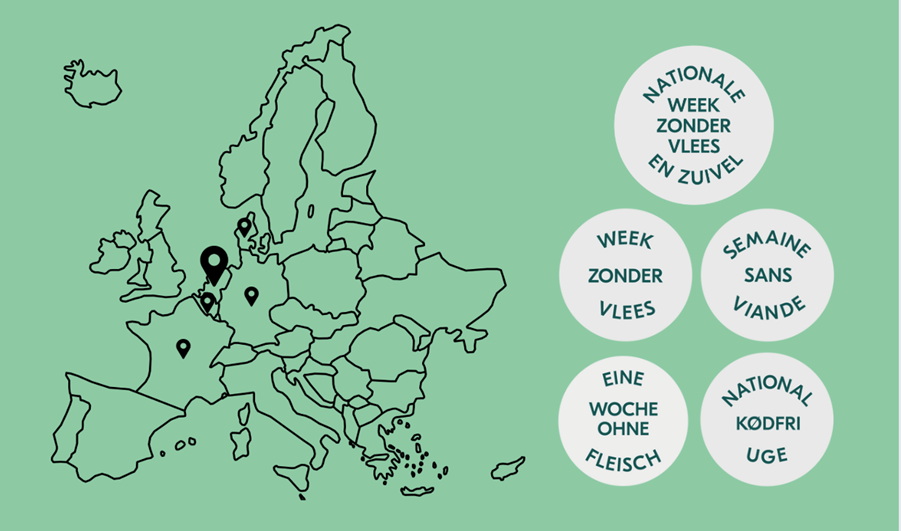
From 2023 to 2025, the foundation rolled out national campaigns in Belgium, Denmark, Germany and France, each tailored to the country’s culture, language and food traditions. After a successful first or second edition, local partners have taken up the torch, ensuring that the movement continues to grow sustainably within each community.
The Week Without Meat campaign challenges people to go without meat for one week, while offering inspiration, recipes and a positive message of choice rather than restriction. Across Europe, the campaign was locally adapted and introduced through events, PR, influencer collaborations and food experiences that brought people together.
Each country’s campaign had its own tone and texture — shaped by its culinary culture and social trends — but all shared the same goal: to make plant-based eating feel accessible, delicious and fun.
Belgium was the first country to launch the Week Without Meat campaign outside the Netherlands in 2023. Known locally as Week Zonder Vlees (Flanders) and Semaine Sans Viande (Wallonia), the campaign quickly resonated with the Belgian public.
In its first edition, 380,000 people took part; by the second year, that number had more than doubled to 850,000 participants, being 9% of the adult population. Besides a big social media and PR campaign, the campaign’s success came from a cozy winter barbecue and a plant-based launch event with media and press in a local restaurant, showing Belgians that eating less meat can fit right into their beloved food culture.
As of 2025, the Belgian campaign has been successfully merged with “Boon voor U”, a Belgian initiative for more plant-based and future-proof options in the hospitality industry and commercial kitchens. Thanks to our partnership with Week Without Meat, they are now bringing that same focus directly to consumers. This partnership ensures that the movement continues to thrive under Belgian leadership, grounded in the country’s own culinary identity.
In 2024, Denmark joined the movement with its first-ever “National Kødfri Uge”. The campaign launched with great visibility, including a presence at Aarhus Food Festival, a plant-based press dinner in Copenhagen, and widespread social media activity.
The result? Around 100,000 Danes joined the challenge in the first edition, with a reach of 19% of the national population.
Following this strong start, the Danish campaign is now being carried forward by former partner; Dyrenes Alliance (Danish Animal Coalition). This local organization is known for its dedication to sustainable food and animal welfare, making it the perfect partner to nurture the next stage of National Kødfri Uge.
Germany embraced the Week Without Meat concept in 2024 with “Eine Woche Ohne Fleisch” and the results were remarkable. More than 5.5 million participants joined the campaign, representing 8% of the German population.
Through a mix of digital storytelling, PR outreach and an innovative food truck tour distributing free plant-based meals across the country, the campaign made a tangible impact on awareness and behaviour.
Today, the German campaign has been adopted by NAHhaft, a respected organization that focuses on sustainable food systems and local transformation. Under their leadership, Eine Woche Ohne Fleisch will continue to inspire change on a national scale.
In 2025, France joined the European movement with its own national campaign: La Grande Semaine Végétale. The campaign focuses on the joy and diversity of French food, proving that plant-based eating can be just as rich, flavourful and rooted in tradition as any other cuisine.
In France, Week Without Meat collaborates with AVF (Association Végétarienne de France), MAKE.org Foundation and Interveg to design this behavioural change campaign. In the first edition, more than 30,000 participants took part in over 590 events, ranging from tastings and workshops to educational activities and two large public festivals. Together, these events exposed more than 2 million people to the benefits of adopting a more plant-forward diet.
Since its first edition in 2018, Week Zonder Vlees in the Netherlands has grown into a national institution with around 2.8 million participants each year. The Dutch campaign continues to act as a source of inspiration, innovation and knowledge for the international movement.
While the European campaigns are now in local hands, the Dutch foundation will focus once again on expanding its domestic impact. The team has big plans for the next steps!
The European rollout of Week Without Meat has shown that behavioural change can cross borders when it is rooted in positivity, culture and taste. What began as a small Dutch idea has now found local homes across Europe, each with its own story, flavour and community.
Behind this transition lies a thoughtful adoption process designed to ensure that the movement would not just spread, but truly take root. After successfully launching national editions in Belgium, Denmark, Germany and France, the Dutch foundation began looking for local organisations who could carry the torch forward — partners whose missions and values aligned with the campaign’s vision of a more sustainable, plant-forward future.
In each country, the team reached out to NGOs and food-focused organisations that already worked on issues like sustainability, climate or animal welfare. Interested groups were invited to share how they would make the campaign their own: how they would adapt it to local culture, what tone and tactics they’d use, and how they could keep it alive for years to come.
Through this process, the foundation selected partners that combined strong local networks with long-term ambition. Some, like Dyrenes Alliance in Denmark and NAHhaft in Germany, were already established voices in the sustainability movement. Others, like Boon voor U in Belgium or the alliance of AVF, Interveg and MAKE.org in France, brought new energy and fresh perspectives. Each was given the freedom to localise the campaign — to reshape the tone, imagery and even the name — while staying true to the shared European mission.
This approach has turned Week Without Meat from a centralised project into a living network of local movements that can grow independently while learning from one another. It ensures that the message continues to resonate — not as a Dutch export, but as a European story of collaboration, creativity and change.
“We are incredibly proud of what we have achieved across Europe,” says founder Isabel Boerdam. “It’s truly special to see how such a small Dutch initiative has managed to take root in several European countries. A good start is half the work, so now we’re passing the baton. It’s important that the campaigns become truly localised and reflect local trends and needs. From now on, we’ll focus on the next step in the Netherlands — because we’re not done yet.”
As the foundation celebrates 10 million participants and hands over the reins to its local partners, one thing is clear: the movement is only just beginning.
Don’t wait for a better world. You might find the solution at the end of your fork. 🍴