

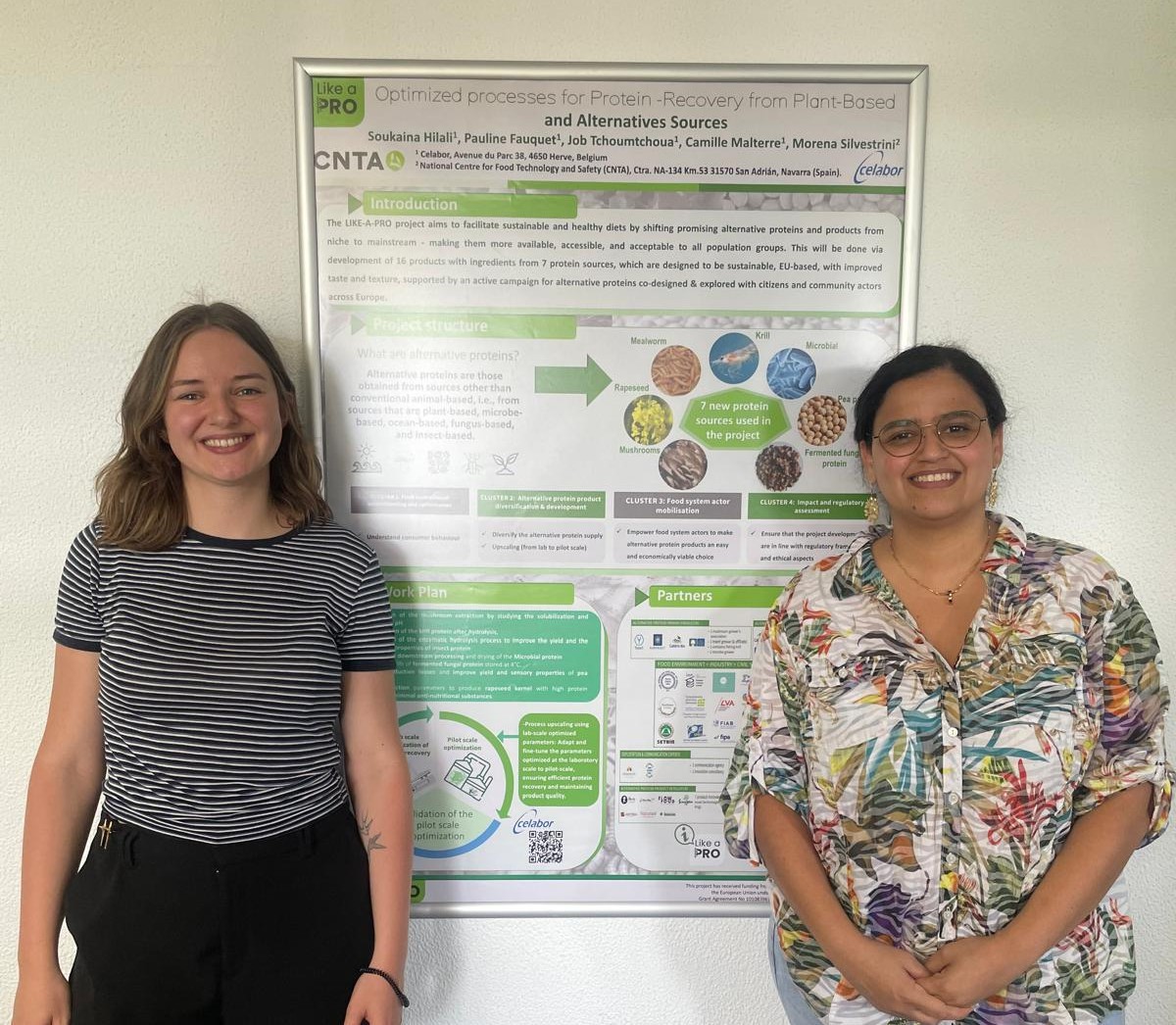
How can alternative proteins become commercially viable ingredients for the food industry? Across Europe, partners in the LIKE-A-PRO project have been working to develop new alternative protein products using ingredients from novel and optimised protein sources. We spoke with two R&D project managers from Celabor to hear about their experiences, the progress made and the challenges that remain.
Alternative proteins have the potential to play an important role in making food systems more sustainable and resilient. But developing new protein sources is only part of the challenge. For food manufacturers to adopt these ingredients, they must be affordable, safe, nutritious and suitable for use in food products. And importantly, they must be available at a scale that meets industrial demands.
This was one of the challenges addressed by the LIKE-A-PRO project. With the ambition of developing new alternative protein products using ingredients from different protein sources – ranging from peas and rapeseed to fungi, insects, microorganisms and krill – the project has brought together partners across Europe to improve and scale up alternative protein production.
At the Belgian research centre Celabor, R&D project managers Soukaina Hilali and Camille Malterre have been involved in supporting and coordinating the development of alternative protein ingredients.
According to the two researchers, one of the biggest challenges is bridging the gap between promising laboratory results and commercially viable production.
- Many alternative protein production processes are still complex and costly. Scaling them up often requires significant investment in equipment and processing technologies. Our goal has been to help ingredient producers improve their processes, increase efficiency and enhance the quality of the final ingredients, they explain.
Depending on the protein source, this has involved increasing protein yields, reducing the number of processing steps, improving texture or removing unwanted flavours. There is no single solution that works for every protein source and each ingredient comes with its own opportunities and technical challenges.
For some producers, the priority has been to extract more protein from the raw material. For others, it has been to improve sensory properties such as taste, colour and texture to make the ingredients more suitable for food applications.
The LIKE-A-PRO partners have worked with a diverse range of ingredients, each offering different possibilities for the food industry.
The developments include:
Pea and fava bean proteins: Sanygran has established industrial-scale production using air classification, a process that separates protein-rich fractions from other components.
Rapeseed protein: Fraunhofer has developed and scaled up a more environmentally friendly extraction process while improving protein quality and reducing off-flavours.
Microbial protein: Calidris Bio has optimised production parameters, doubling production yield and reducing production costs by 50%.
Mealworm protein: Ÿnsect has improved sensory properties, including reducing a sandy mouthfeel, and carried out semi-industrial scale-up.
Krill protein: Rimfrost has scaled up a purification process to reduce unwanted odours and improve sensory quality.
Mushroom stem protein: CTICH has developed a protein ingredient from stems left over from the cultivation of white button, oyster and shiitake mushrooms.
Fermented fungal protein: Kinoko has introduced automation strategies to improve efficiency and support the scaling of fungal protein production.
Together, these developments demonstrate how targeted improvements in processing can help address some of the barriers preventing alternative proteins from reaching the market.
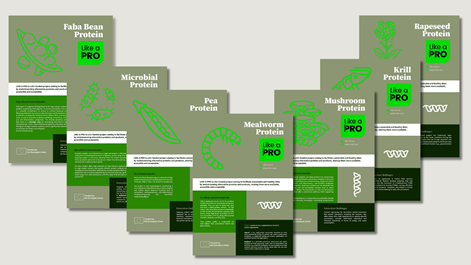
Check out the seven factsheets here
One of the project's most significant achievements is the progress made in scaling up production. Spanish ingredient producer Sanygran has reached industrial-scale production of pea and fava bean proteins, with a protein content of up to 55%. The company has established a production capacity of 3,000–3,600 kg of protein per hour and reports that the process is operating profitably.
For Soukaina Hilali and Camille Malterre, this is an important example of what can be achieved when technological development and economic viability are considered together.
Another example comes from Fraunhofer, which has developed and scaled up an innovative extraction process for rapeseed. The process enables the simultaneous recovery of rapeseed oil and protein using more environmentally friendly solvents, avoiding conventional petroleum-based solvents such as hexane.
Meanwhile, Calidris Bio has doubled its microbial protein production yield while cutting production costs by half.
Rimfrost has also made progress, developing a krill protein ingredient containing more than 70% protein and a complete essential amino acid profile.
These results illustrate that improving production processes can create value in several ways: by reducing costs, increasing output, improving ingredient quality and making better use of raw materials.
Although scaling up production is essential, producing more protein is not enough. For alternative proteins to become useful food ingredients, they must also meet the nutritional, functional and safety requirements of the food industry. Throughout LIKE-A-PRO, the development of ingredients has therefore been accompanied by continuous testing and evaluation.
Project partner CNTA has analysed the ingredients at different stages of development to monitor their techno-functional properties including characteristics that determine how an ingredient behaves when incorporated into food products.
At the same time, GAIKER has monitored ingredient safety and quality, including nutritional profiles, digestibility and the presence of potential contaminants and antinutritional factors. Ingredient producers have also worked under food-grade conditions to minimise contamination risks.
- The development of alternative proteins requires a holistic approach. Improving production yields and reducing costs must go hand in hand with ensuring nutritional quality, food safety and the functional properties that food manufacturers need," Soukaina Hilali and Camille Malterre explain.
This combination of process optimisation, quality monitoring and scale-up is essential for bringing new ingredients closer to commercial food production.
Expanding the range of alternative protein ingredients could help reduce dependence on a limited number of protein sources while creating new opportunities for food and ingredient producers. However, challenges remain. Production costs, industrial scalability, regulatory requirements and consumer acceptance continue to influence how quickly new protein sources can enter the market. Some ingredients, including certain microbial and insect proteins, may also require authorisation under the EU Novel Food Regulation.
The experiences from LIKE-A-PRO underline that technological innovation alone is not sufficient. Commercial success also depends on ingredient quality, economic feasibility, food safety and the ability to meet market needs.
For food and ingredient producers, the message is clear: these factors must be considered together from the earliest stages of development.
By combining expertise across research institutions and industry, LIKE-A-PRO is helping advance alternative proteins from promising raw materials towards ingredients with real potential for industrial food production.
And as the project results demonstrate, progress is already being made - one improved process, ingredient and production line at a time.