

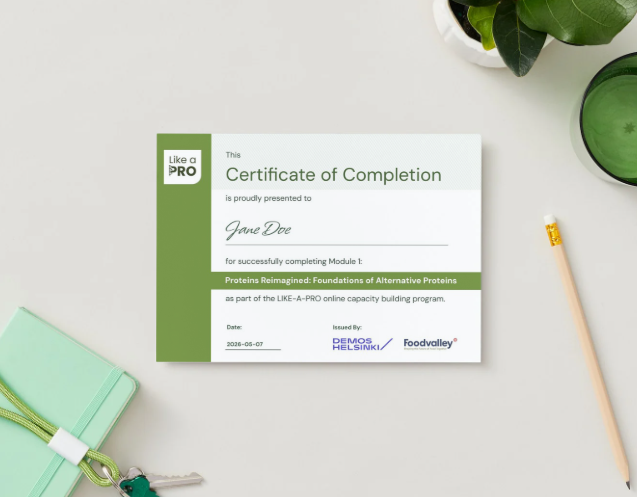
Two free modules, expert and producer videos, and a LinkedIn-ready certificate. The LIKE-A-PRO Phase 3 Online Training is now live on Foodleap, open to anyone interested in the future of protein.
Alternative proteins have become a regular feature of Europe's food debate, appearing in policy discussions, climate strategies, and supermarket aisles alike. Yet for many people, the topic remains difficult to grasp, a subject more often debated by experts than explained in everyday terms. Reliable, accessible learning resources are still in short supply.
The LIKE-A-PRO Phase 3 Online Training was developed to help close that gap. Now live on the Foodleap platform, it consists of two short, self-paced modules, free for anyone who wants to understand what alternative proteins are, why they matter, and how the transition is taking shape across Europe.
Module 1 — Proteins Reimagined: Foundations of Alternative Proteins
Whether you are curious about what is on your plate, working in the food industry, or simply wondering what all the fuss about alternative proteins is about, Module 1 is the place to start. It provides a solid grounding in what alternative proteins are, where they come from, why they matter for our health and the planet, and what the rules around them look like in Europe.
What is included:
A 29-page reading covering everything from protein basics to environmental impact and EU regulations.
Two short cooking videos with practical tips on cooking with alternative proteins.
A short quiz — complete it and receive your LinkedIn certificate.
No prior knowledge is needed. Just an open mind and a bit of curiosity.
Module 2 — Understanding the Protein Transition: Consumer & Producer Perspectives
Module 2 picks up where Module 1 leaves off and goes deeper into the real-world dynamics of how alternative proteins are produced, marketed, and chosen. It brings together two complementary perspectives: what consumers across Europe actually think, feel, and do when it comes to alternative proteins, and how pioneering producers are developing the next generation of sustainable ingredients.
What is included:
A research-based reading exploring what drives and what hinders the adoption of alternative proteins across European markets, with four practical angles for making change happen
A video on consumer behaviour insights from over 3,000 Europeans across 11 countries, complementing the reading with real voices and data
Three producer videos showcasing innovations in mushroom stem protein, microbial protein, and rapeseed protein — straight from the people building the next generation of protein
A short quiz — complete it and receive your LinkedIn certificate
New to the topic? We recommend starting with Module 1 to build your foundations before diving in.
The training is aimed at a broad audience: food industry professionals, researchers working on sustainable food, educators, students, and anyone curious about what is on their plate. No prior knowledge is required, and the modules can be completed in a couple of hours at your own pace. Those new to the topic should find them approachable, while readers already working in the field will still find useful depth in the supporting materials.
The development of the modules was a collaborative effort across several consortium partners.
At Demos Helsinki, Satu Lähteenoja, Tanya Sahdev and Ira Nääppä coordinated the design and delivery of the capacity building work in the project, of which these modules form a central part, and co-issue the Certificate of Completion together with Foodvalley.
At Foodvalley, Suzan D'Rose, Minke Burgers, and Sylvia Raijmakers led the development of Module 1 on protein foundations and reformulation, while also organising the modules on the Foodleap platform and supporting overall delivery and moderation.
At CSCP, Arlind Xhelili and Jennifer Wiegard shaped the consumer perspective of Module 2, distilling findings from the LIKE-A-PRO Living Labs — including the consumer insights dataset spanning more than 3,700 participants across 11 European countries — into a research-based reading and an accompanying video.
The cooking videos in Module 1 were contributed by Maxime Willems and Candela Saman from Nursh, as well as John Regefalk and Jonathan Pommerenk from BCC, whose workshops included showing how alternative proteins can be put to use in the kitchen — translating the foundations of the module into practical, hands-on tips.
The producer videos in Module 2 were made possible by the partners building the next generation of alternative proteins: Lieve Hoflack from Calidris Bio on microbial biomass protein, Rebeca Lavega from CTICH on mushroom stem protein, and Robert Hartmann from Fraunhofer on rapeseed protein. Their contributions bring the research to life by showing what alternative protein production looks like in practice.
Each module concludes with a short quiz. Once completed, learners receive a Certificate of Completion issued by Demos Helsinki and Foodvalley as part of the LIKE-A-PRO online capacity building programme. The certificates are designed to be shared on LinkedIn, and we warmly encourage you to do so. A short post tagging the project goes a long way in helping more people discover the modules, and is one of the most effective ways to support the dissemination of the training.
The training is hosted on Foodleap, Foodvalley's online community platform for the food sector. To access the modules, register for free at https://www.foodleap.com/ and join the Alt Proteins Like A Pro community.
Certification is open until the end of October 2026.
A couple of hours with the modules should leave you with a clearer view of where alternative proteins fit in — in your work, in your kitchen, and in the broader conversation about how Europe eats.